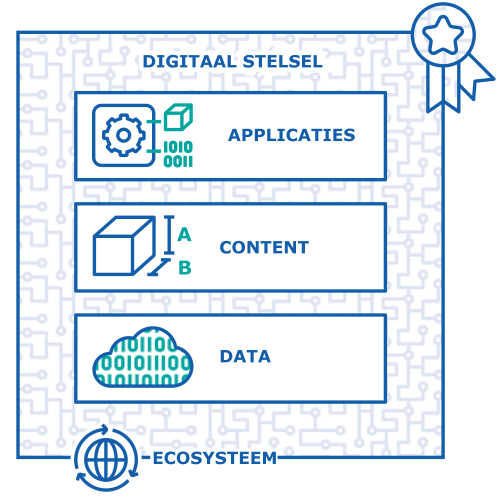
Digital System

BIM stands for collaboration. Not only the collaboration of people, (Building Information Management) but also by using technology that enables collaboration (Building Information Modelling). Building according to the BIM philosophy will only be successful with a perfect blend of collaboration and technology.

A digital system or another form of collaboration?

A proprietary digital system?

A strong end user (such as AWV, Regie Der Gebouwen / Toyota, Albert Heijn) can open their own system (or a third-party system) to users, manufacturers, and partners. This is a closed collaboration.

A digital platform?

A digital platform is an initiative by a party that establishes its own rules and offers services to independent parties wishing to collaborate under those conditions (e.g., BIM360-Autodesk Forge / Airbnb).

A digital system?

A general digital system is established when multiple parties collaborate digitally and make general agreements regarding standards, processes, and roles.
The ownership and use of data are well regulated.

It is clear that BIM should not be organised through the proprietary systems of end users. Consequently, the other stakeholders would have to modify their processes and working methodologies for each end user. This inefficiency is indirectly passed on to the end users who stick to their own systems. This form of collaboration is therefore not suitable for them either.

Selecting platforms and allowing competition (e.g., Trivago versus Booking.com) while systems are sector-wide (e.g., banking sector) and must remain non-competitive.

A digital system is not sufficient

In digital systems, commercial activities must be able to unfold in the form of software companies that develop data, content, applications, and services. A digital system must enable this; moreover, a digital system must provide recognition to the platforms that operate in accordance with the regulations of the relevant digital system compliant platforms.

Digital systems must also regulate a number of elements; there should be something akin to a GDPR for the digital realm:

  • Identity of individuals, companies, organisations, …
  • Data policy regarding the processing of information
  • ‘Delete and forget’ principle
  • Transferability of data (subject to conditions)
  • Property rights, usage rights, and copyright properly arranged

Why is a digital system for BIM necessary?

A photograph uploaded by a consumer on Facebook, where Facebook may utilise that photograph for all purposes, may not be considered problematic as it remains within the private sphere of the consumer. However, the situation is entirely different in the case of BIM.

From a BIM model, a significant amount of information can be extracted, for instance regarding how a door is secured in a prison, the locations of security cameras in a high-security building, and the position of the emergency generator in a tunnel. Plugins for BIM modelling software can retrieve this information and relay it to the supplier of the plugin.

Furthermore, there are BIM modelling platforms and BIM collaboration platforms that state in their general terms and conditions that all information contained in the uploaded BIM models can be analysed and monetised by them.

This must be avoided.

Exceptions to the general terms and conditions

Large end-users may negotiate different conditions for their projects with a BIM collaboration platform, but they often involve their (usually smaller) users in this process. As long as these users remain within the projects of those large end-users on such a platform, there is no issue. However, they often do not realise that, as users, they cannot use the platform for their other projects without risk.

When users do realise this, they often fail to obtain the necessary deviations and exceptions to the general conditions of such platforms. An additional difficulty is often that such platforms are organised according to American (or Anglo-Saxon) law, which follows a very different legal logic than European law.

What needs to be arranged? And by whom?

Under the motto “sharing is the new multiplying,” considerable arrangements must be made to ensure that stakeholders feel safe and comfortable when engaging in sharing activities.

  • All actors (users, manufacturers, partners, and end-users) must operate according to specific roles.
  • It must be established who uses which information from each of the aforementioned parties and for what purposes.

All these matters constitute the regulations of the digital system. This should be managed by the Federal Government.

Legal aspects – General:

  • Establishing a number of principles
  • Elaboration of a number of types of agreements for each of the involved parties (actors)
  • Maintaining and publishing jurisdiction

Legal aspects – products & context

  • Products: this has mostly been solved already
  • Environment: this has mostly been solved already
  • Building/context: arrangements still need to be made for this (e.g. potential conflict with the copyright of architects?)

There needs to be a kind of translation of several principles from the physical world to the digital world.

General note:

The aspects concerning the digital system transcend the interests of the stakeholders within the TechBiM ecosystem and are applicable to all actors in the construction sector. There is a concerted effort to elevate this to a level beyond TechBiM.