Standardisation on 3 layers

BIM is a significant innovation in the construction process, focusing on collaboration and transparency. The implementation of BIM requires effective collaboration within one’s own organisation, with other parties in the supply chain, and results in cost savings through more efficient work preparation, estimation, and execution.

The increasing use of BIM by the various stakeholders in the construction process highlights the need for standardisation.
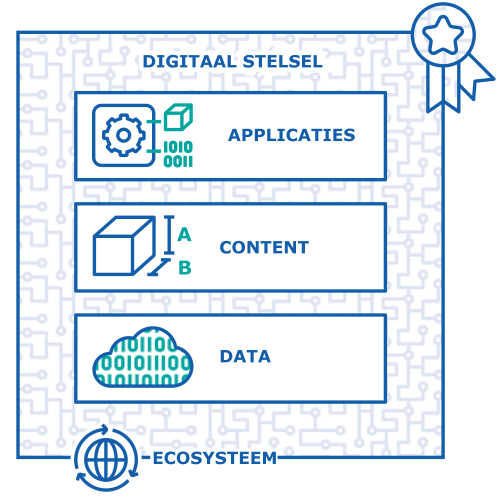

In analysing BIM standards in 2018, we identified two fundamental gaps.
With TechBiM, we resolve one issue so that the other can be addressed by the BIM users themselves.

2 fundamental shortcomings

The existing BIM standards do not provide digital building blocks or procedural agreements. The abbreviation BIM also reflects two aspects, standing for Building Information Modelling (where the digital building blocks are crucial) and Building Information Management (the procedural aspect).

  • The digital building blocks are the fundamental elements required to realise a BIM model. TechBiM established that there was no standardization in this area, while the various stakeholders in the construction chain were nonetheless seeking guidance. How can one efficiently realise a ‘digital twin’ without standardised and reliable digital building blocks? TechBiM provides the solution to this problem.
  • Procedural agreements are necessary to realise the flow of information from both the digital version (digital twin) of the building and the physical building itself based on its digital twin. TechBiM does not focus on this. However, due to the standardisation of the digital building blocks by TechBiM, the various BIM actors can take the initiative themselves.

Digital building blocks

TechBiM addresses this necessity and has the mission to provide the construction and installation sector with common reliable digital building blocks and to promote their adoption in every possible manner.

In the realm of digital construction, there are 3 layers: the data layer, the content layer, and the application layer. The content layer establishes the digital building blocks (objects), which are essential for creating a BIM model, and serves as the connecting element between the data layer and the application layer. Applications ensure a correct geometric representation of products by combining data from the data layer with objects from the content layer.

Data layer

Herein, we refer to Product Data (technical, financial, logistical, maintenance, etc.) of the physical products. The available standards are Etim, VDI3805, COBie, CEN TC 442, buildingSMART Data Dictionaries, …

Data are the values that are assigned to the parameters of the BIM objects (from the content layer), among other things.

These may be generic values or data that are specific to a particular manufacturer. It is the responsibility of the software partners within the ecosystem to assist manufacturers, if necessary, in the structured presentation of their data to the market, either through their own application or via platforms.

Content layer

These are objects (digital building blocks) with specific geometry and functionality that are used in BIM modelling software (BMS) such as Revit, DDS-CAD, BricsCAD, Archicad, and others.

As objects differ per BMS, cooperation agreements must be established for each BMS.

Due to the multitude of actors involved, this standardisation per BMS was realised only to a limited extent spontaneously. Driven by the ambition to address this shortcoming, the open source TechBiM Content has become the sector standard for projects in Belgium.

Application layer

This is the software that supplements the BIM modelling software by connecting data and content (calculations, optimisation, product selection, etc.).

Applications can run directly on the BMS as a plugin, or they can establish an interaction with the BMS via a plugin or file exchange, and they may be either desktop or cloud-based. The provider can be a Manufacturer, a Partner, but Users themselves can also develop applications. It is important that they are reliable. Compliance with the Digital System provides guarantees in this regard.

Important note

TechBiM aims to establish the necessary agreements within the respective BIM modelling software (BMS). The exchange and collaboration between different BMS systems is delegated by TechBiM to buildingSMART (among others, via the IFC exchange format).

Although it is true that the activities of TechBiM are, in fact, a necessary prerequisite for various BMS systems to communicate with each other. How could it be that if there is not yet smooth collaboration within a single BMS, we might expect to collaborate seamlessly across different BMSs?